PRIVATE WELLS · PRACTICAL DECISIONS
Your water.
Your constraints.
A clearer decision.
Before choosing treatment, understand what your water supply can actually support.
Measured inputs. Documented requirements. Visible uncertainty.
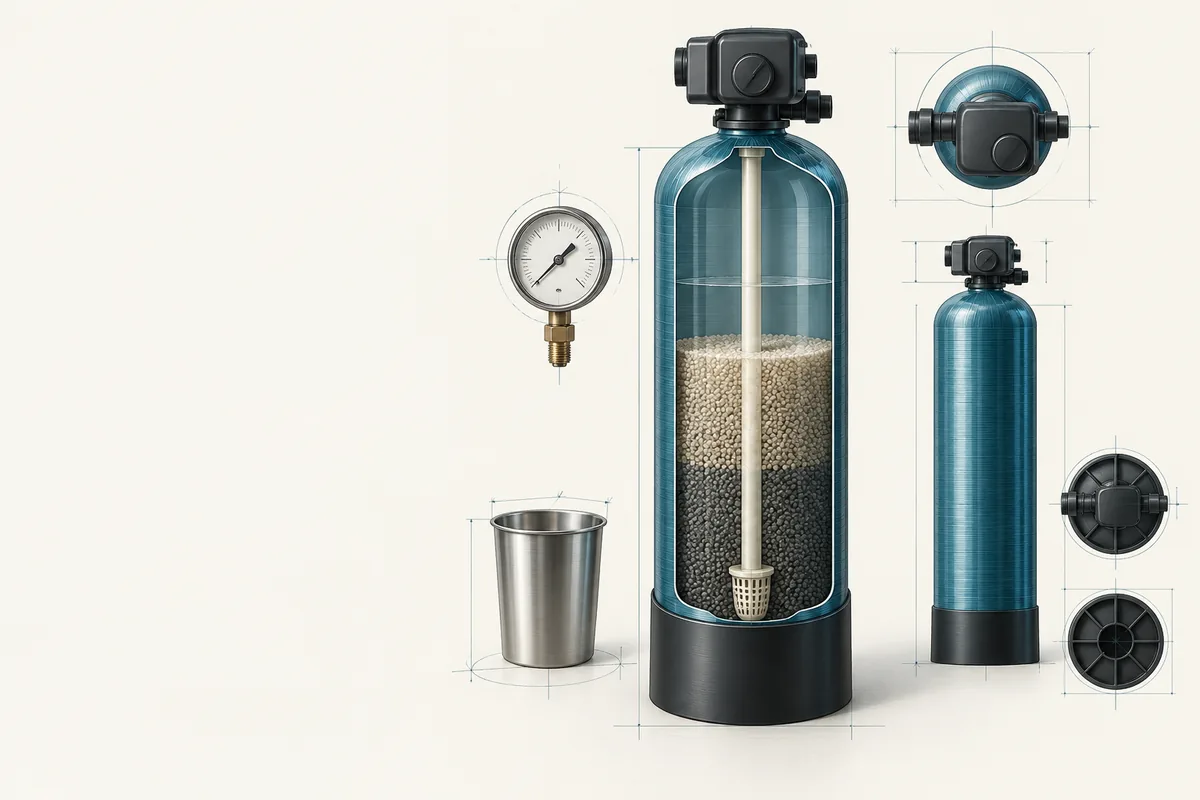
A tank size is not a pump specification.
The useful question is whether your measured supply matches the documented conditions.
Build your comparison →Start with the constraint that changes the decision.
Our first resources focus on available flow and backwash demand: two questions that can rule out an unsuitable system before you spend money.
Record available water flow
Turn a volume-and-time observation into useful data, with pressure, location, and duration kept alongside it.
02 / COMPARISONCheck backwash flow demand
Compare an observation with the requirement in your exact system manual. Keep unresolved conditions visible.
03 / UNDERSTANDINGRead the field guides
Learn why valve ratings, tank diameter, pump nameplates, and well yield answer different questions.
OBSERVE / FIND / VERIFY
Troubleshoot Your Well System
Start with what changed, or search for a component or measurement. Use the guides to identify the evidence behind your next step.
Symptoms & Aesthetics
Start with changes in color, odor, taste or visible sediment.
DIAGNOSTIC SILOMechanical Troubleshooting
Trace low pressure, cycling and changes in water delivery.
DIAGNOSTIC SILOTreatment & Chemistry
Connect treatment questions with test results and system conditions.
DIAGNOSTIC SILOHardware Rebuilds & Parts
Identify equipment, match documentation and find parts information.
MEASURERecord Your Flow
Convert collected volume and time into a flow record with its measurement conditions.
MODEL A DEMAND EVENTCheck Storage & Refill
Track usable water through treatment cycles, household demand and supported refill.
Read our evidence and editorial standards · See the calculation methods