Water that turns clear as bubbles rise may contain released air. Water that leaves sediment or stays hazy needs a different investigation. A glass observation is useful for sorting clues, but it cannot establish drinking-water safety or identify a gas.
Optional: flow calculator for treatment planning
INTERACTIVE WATER BALANCE / V1.0
Well Storage & Refill Calculator
Will usable stored water cover your entered demand sequence? Add each water-use stage, then compare the remaining water with the reserve you need to retain.
Calculation method and limits
Within a stage, flows are constant. End water = min(usable capacity, starting water + (refill − treatment − household flow) × minutes). The lowest balance in each constant-rate stage occurs at one of its endpoints. Inflow above capacity is not carried into the next stage. A balance below zero represents unmet demand, not physically available water.
The model works backward from the required reserve to find the least starting usable water that can retain that reserve throughout the sequence. If the required water exceeds usable capacity at any stage, no starting level within the entered capacity can cover that sequence. Arithmetic comparisons use a small floating-point tolerance.
Post-event refill time returns the reservoir to its entered starting level. It is not aquifer recovery time. If net refill is zero or negative and water was depleted, no finite refill time exists under those assumptions. A failed demand sequence has no valid recovery estimate.
Gallons alone do not establish delivery at pressure, sustainable well yield, drinking-water safety or an installation design. Source assessment, permitted operating levels, controls and equipment requirements need separate evidence. See the water-balance method, the worked example and the guide’s sources and review status.
Observe a Glass Without Treating It as a Safety Test
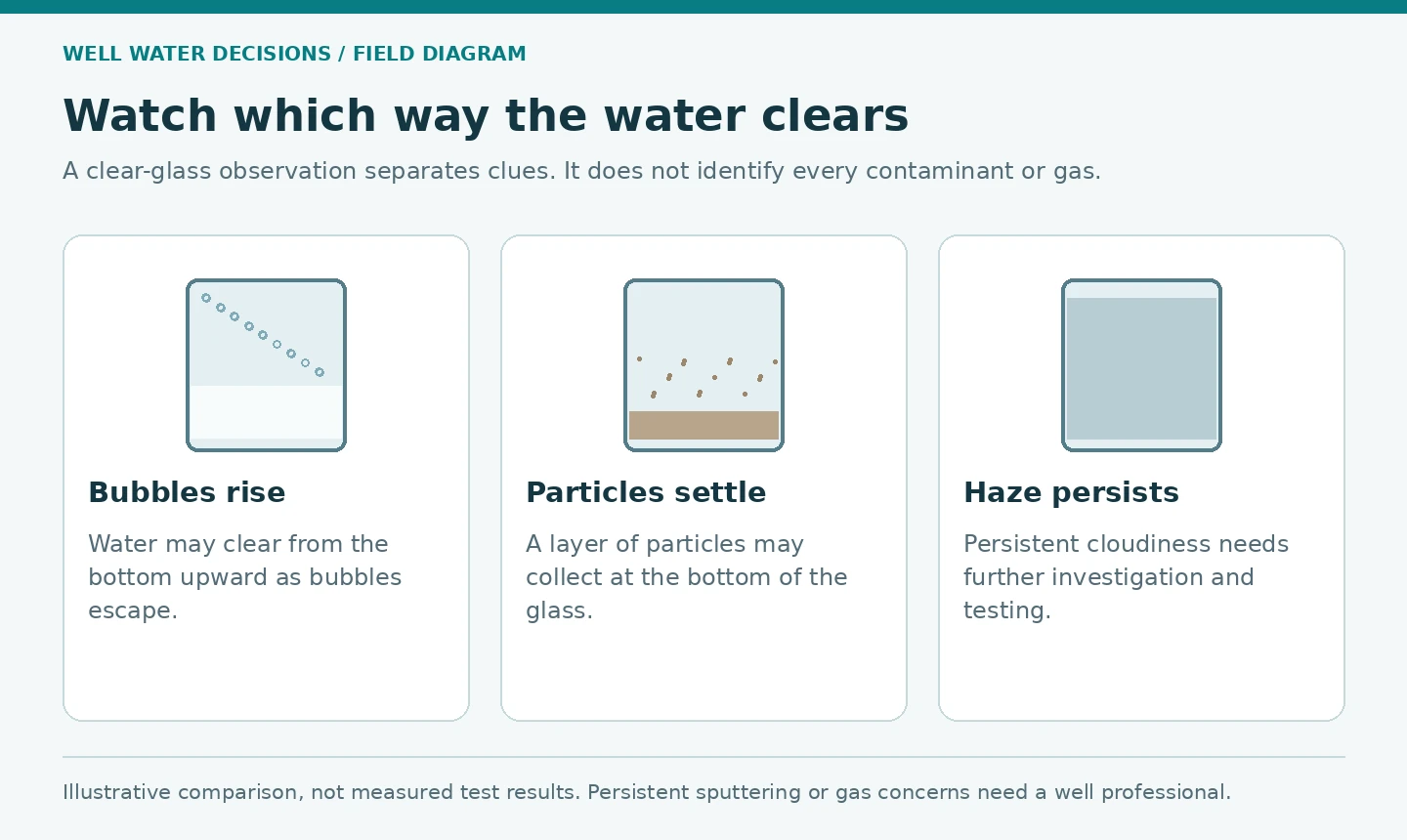
Draw a small cold-water observation sample into a clean clear glass and set it on a stable surface. Note what happens over the next few minutes. USGS explains that pressure and temperature changes can release air as fine bubbles. As they rise, the water may clear from the bottom upward.
A layer of settled particles or persistent haze is a reason for further investigation. It does not, by itself, identify clay, silica, bacteria, or a particular metal. The informal glass is not a laboratory sample container.
Compare Locations and Temperatures
| Pattern | Investigation to prioritize |
|---|---|
| One faucet; other cold taps clear | Fixture aeration, recent maintenance, and local components. |
| Several hot taps; cold taps clear | Hot-water equipment and plumbing; separate bubbles from particles. |
| Several cold taps or confirmed untreated supply | Well, common plumbing, and treatment stages. |
| Started after a filter or softener change | Correct installation and the model’s commissioning or restart procedure. |
Do not call a faucet “raw water” until its treatment routing is confirmed. Record recent pump work, filter changes, storms, and loss of pressure. A problem absent from one observation may still be intermittent.
Sputtering or Recurring Gas Needs More Than a Bubble Check
Persistent gas release, repeated sputtering, or a new change following well work deserves assessment by a well professional. Methane can occur in some groundwater settings; it is colorless and odorless. The absence of a smell does not rule it out, and clearing in a glass does not identify the gas.
Never use a match, lighter, or other ignition source to test gas from water. Do not enter a well pit or confined space to investigate. Suspected fuel-gas leakage, a gas alarm, or a strong unexplained gas odor requires leaving the area and contacting the relevant emergency service from outside.
For a hot-water system returning to service after extended non-use, consult the heater’s instructions about possible hydrogen accumulation. Do not assume the same mechanism applies to every cold-water well symptom.
Choose Tests From the History and Symptoms
Ask a certified drinking-water laboratory or health department which tests fit the change. EPA recommends testing promptly after well repairs, significant nearby changes such as flooding, or a change in water quality. The laboratory may advise turbidity, metals, or gas-specific sampling in addition to routine private-well tests.
Gas samples require appropriate collection and handling. Do not pour an observation glass into a shipping bottle and expect a reliable gas result. Follow the laboratory’s instructions before collection.
Do not run an outside hose continuously to “clear the well” without a contractor’s plan, especially where supply is limited. Falling flow, unusual cycling, or loss of pressure warrants stopping the discharge and obtaining service. Select filtration only after the cause and well capability are understood. Our low-yield well guide explains why short-term faucet flow and sustainable supply are different.
Common Questions
Is milky water safe if it clears in a glass?
Clearing can be consistent with bubbles, but it does not test for pathogens, dissolved contaminants, or the identity of a gas. Use your well’s testing history and seek advice for sudden or persistent changes.
Can I identify silica because water stays cloudy?
No. Persistent haze does not identify a substance. A laboratory and the system history are needed to distinguish possible solids or other causes before selecting treatment.