
Stop using ice with unexplained black particles until you establish their source. New-filter carbon fines are one possibility; worn ice-maker components and incoming particles are others. Do not assume every black speck is harmless carbon or mold.
Optional: flow calculator for treatment planning
INTERACTIVE WATER BALANCE / V1.0
Well Storage & Refill Calculator
Will usable stored water cover your entered demand sequence? Add each water-use stage, then compare the remaining water with the reserve you need to retain.
Calculation method and limits
Within a stage, flows are constant. End water = min(usable capacity, starting water + (refill − treatment − household flow) × minutes). The lowest balance in each constant-rate stage occurs at one of its endpoints. Inflow above capacity is not carried into the next stage. A balance below zero represents unmet demand, not physically available water.
The model works backward from the required reserve to find the least starting usable water that can retain that reserve throughout the sequence. If the required water exceeds usable capacity at any stage, no starting level within the entered capacity can cover that sequence. Arithmetic comparisons use a small floating-point tolerance.
Post-event refill time returns the reservoir to its entered starting level. It is not aquifer recovery time. If net refill is zero or negative and water was depleted, no finite refill time exists under those assumptions. A failed demand sequence has no valid recovery estimate.
Gallons alone do not establish delivery at pressure, sustainable well yield, drinking-water safety or an installation design. Source assessment, permitted operating levels, controls and equipment requirements need separate evidence. See the water-balance method, the worked example and the guide’s sources and review status.
Compare Water, Fresh Ice, and the Storage Bin
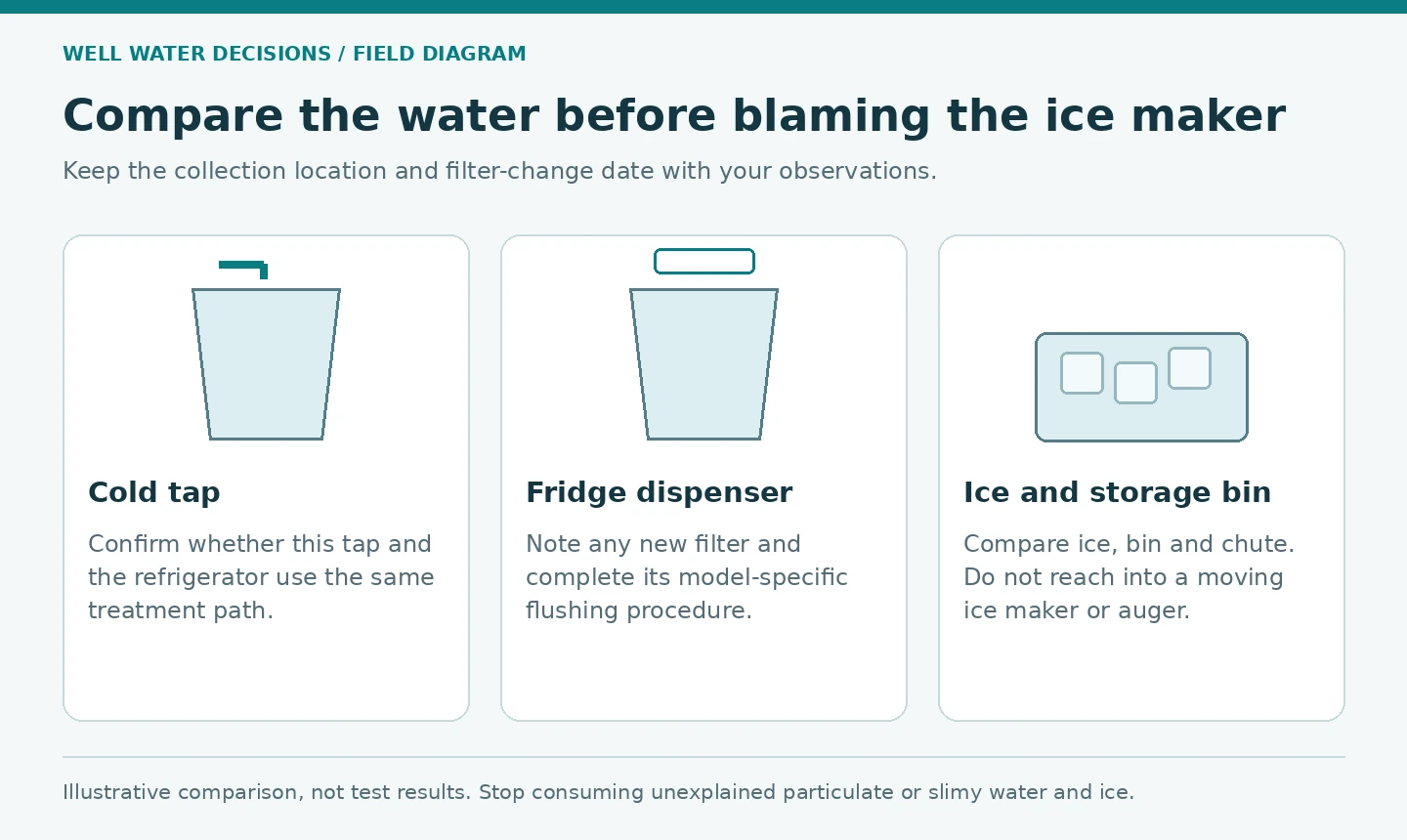
| Observation | Next check |
|---|---|
| Particles in the refrigerator water and ice after a filter change | Verify the filter fit and its exact flushing instructions. |
| Ice affected but dispenser water appears clear | Have the ice maker, bin, and dispensing path assessed; their water paths may differ. |
| Tap water also contains particles | Investigate the shared supply and treatment path. |
| Debris visible in the bin or chute | Follow removable-part cleaning instructions; check for wear or damaged parts. |
Use separate clean containers to document ordinary tap and dispenser water. Record the filter installation date. Compare newly produced ice with stored ice only when it can be done without reaching into an operating mechanism. These comparisons narrow the investigation; they cannot certify the water or ice as safe.
If a Filter Was Just Replaced
GE lists carbon particles from a new filter as one possible source of black ice. Follow the refrigerator and filter instructions for installation and flushing. The required volume and ice-discard procedure vary; a generic number of gallons is not reliable for every model.
Check the exact filter identifier and the refrigerator’s approved replacement list. Do not force an incompatible filter into its housing. If particles persist after the prescribed commissioning procedure, contact the manufacturer rather than repeatedly flushing indefinitely.
When the Ice Maker Needs Service
GE also identifies deterioration of an ice-maker mold body as a possible cause. That is an equipment issue, not something a whole-house filter necessarily fixes. Record model details, photos of affected ice, unusual sounds, and visible damage without dismantling the ice maker.
Keep hands and tools away from the auger, moving ice-maker parts, and any exposed wiring. Follow the manual’s shutdown and removal instructions for a removable ice bin. Do not sand, paint, or coat an ice-making surface, and do not break ice loose with a sharp tool.
Clean a removable bin only by the approved method; refrigerator plastic parts are not automatically dishwasher-safe. A recurring slime or film requires a different cleaning investigation from hard component fragments.
When to Investigate the Well
If particles also appear at fixtures supplied through the same treatment path, use our whole-house black-speck guide. Ask a laboratory or water professional about the sample needed to identify the material. A total-dissolved-solids reading does not identify black particles or measure hardness by itself.
For white or cloudy ice rather than black debris, see cloudy ice and refrigerator water. Do not buy a softener to solve unexplained black specks without confirming the cause. Water that looks clear may still require the routine private-well tests recommended locally.
Common Questions
Are black specks in ice always carbon from the filter?
No. GE also lists ice-maker mold deterioration as a possible source, and incoming particles or debris elsewhere may be involved. A recent filter change is a clue; it does not identify every particle.
Should I replace the ice maker before the filter?
Establish the affected locations and recent service history first. Follow the model’s filter commissioning instructions if relevant, and have persistent ice-only particles or visible component damage assessed before ordering parts.