
A cloudy glass can have a removable coating or permanent surface damage. The first step is to determine whether any haze can be removed safely. Do not assume that more softening, more detergent, or a stronger cleaner will solve both problems.
Optional: flow calculator for treatment planning
INTERACTIVE WATER BALANCE / V1.0
Well Storage & Refill Calculator
Will usable stored water cover your entered demand sequence? Add each water-use stage, then compare the remaining water with the reserve you need to retain.
Calculation method and limits
Within a stage, flows are constant. End water = min(usable capacity, starting water + (refill − treatment − household flow) × minutes). The lowest balance in each constant-rate stage occurs at one of its endpoints. Inflow above capacity is not carried into the next stage. A balance below zero represents unmet demand, not physically available water.
The model works backward from the required reserve to find the least starting usable water that can retain that reserve throughout the sequence. If the required water exceeds usable capacity at any stage, no starting level within the entered capacity can cover that sequence. Arithmetic comparisons use a small floating-point tolerance.
Post-event refill time returns the reservoir to its entered starting level. It is not aquifer recovery time. If net refill is zero or negative and water was depleted, no finite refill time exists under those assumptions. A failed demand sequence has no valid recovery estimate.
Gallons alone do not establish delivery at pressure, sustainable well yield, drinking-water safety or an installation design. Source assessment, permitted operating levels, controls and equipment requirements need separate evidence. See the water-balance method, the worked example and the guide’s sources and review status.
Check a Small Area Before Treating the Whole Load
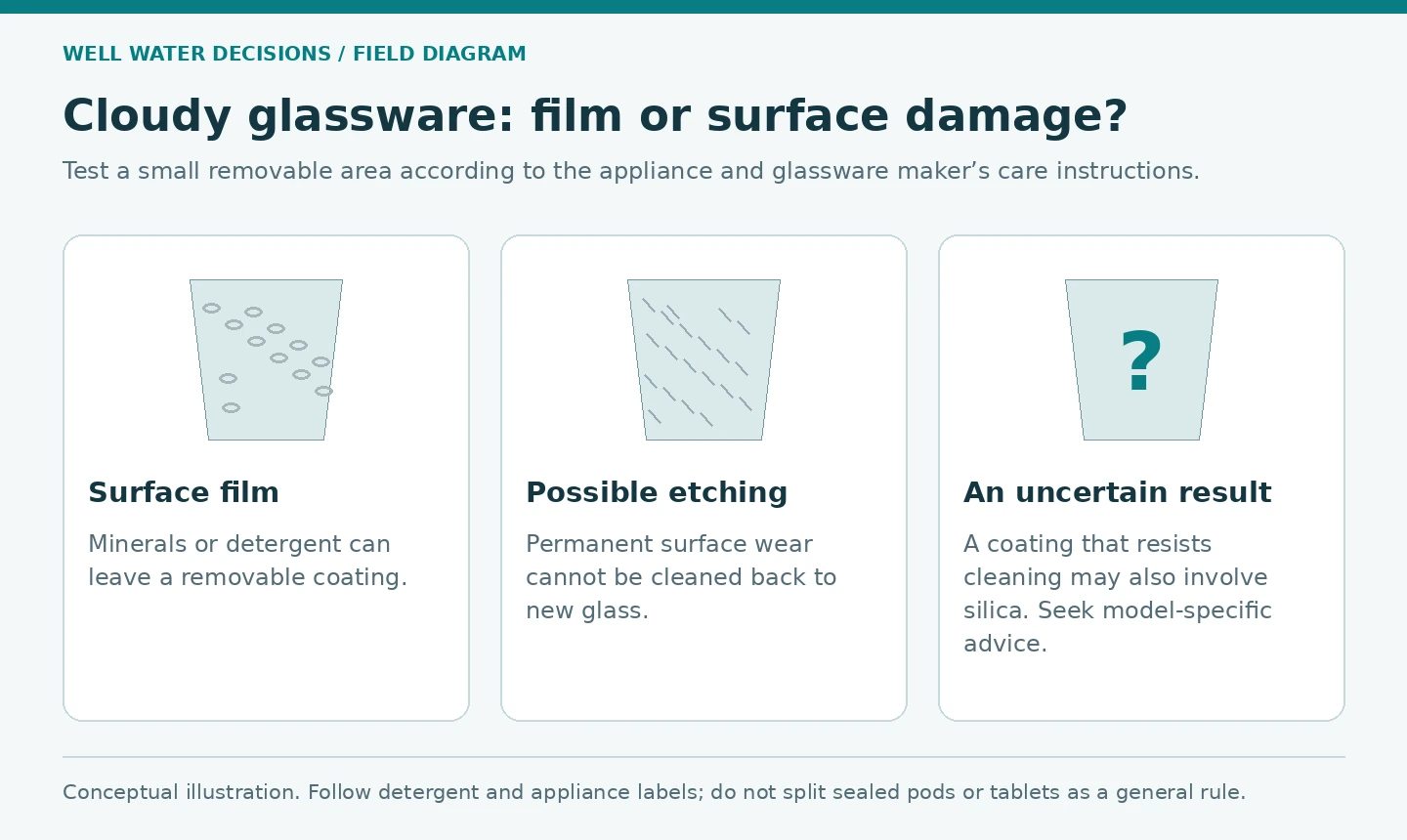
For plain dishwasher-safe glass where the maker permits it, Whirlpool suggests gently testing a small hazy area with a little vinegar. If it clears, a removable film contributed. If it does not, Whirlpool notes that either etching or silica film may be involved. Avoid acids on decorated, coated, crystal, or other glassware unless its maker permits them.
Etching is damage to the glass surface and cannot be cleaned back to its original finish. A failed spot check alone is not a conclusive etching test.
Match the Response to the Evidence
| Finding | Useful response |
|---|---|
| A film lifts from a small compatible test area | Review deposits, detergent use, rinse performance, and measured hardness. |
| Haze remains or the surface is worn | Check glassware and appliance guidance; avoid repeated aggressive cleaning. |
| Problem started after installing a softener | Measure the water supplied to the dishwasher and review detergent guidance for softened water. |
| Food residue, blocked spray, or detergent left in the cup | Correct loading and follow user-maintenance instructions; do not assume a well-water chemistry problem. |
GE, Frigidaire, and Whirlpool all connect detergent use with water conditions. Their instructions vary by appliance and formulation. The water feeding the dishwasher matters more than a regional hardness estimate or the raw well result alone.
Change One Supported Variable at a Time
- Confirm that the affected items are dishwasher-safe and follow their care instructions.
- Measure hardness at the relevant treated supply. A TDS meter does not replace a hardness measurement.
- Use automatic dishwasher detergent according to the product label and appliance instructions. Adjust powder or liquid only within those directions; do not cut, puncture, or divide detergent packets to improvise a smaller dose.
- Check that glasses are spaced for spray access and that items do not block the dispenser or spray arm. Use a suitable cycle for the load.
- Change rinse-aid or cycle settings only as the model’s guidance supports, and record the outcome on an ordinary compatible load.
Do Not Reconfigure Well Treatment From One Hazy Load
Repeated filming with documented hardness may justify checking softener performance. It does not justify assuming a universal target, bypassing treatment indefinitely, or adding a guessed chemical treatment. Corrosion, mineral scale, food soil, and etching are separate tasks.
For deposits elsewhere, compare our white scale and hardness guide. If the water itself is milky before it enters the machine, start with the cloudy-water observations. Manufacturer guidance and laboratory results should determine whether a treatment change is useful.
Common Questions
If vinegar does not clear the haze, is etching confirmed?
No. Whirlpool notes that a haze that does not lift may be etching or a silica film. Follow the glassware and dishwasher manufacturer’s guidance rather than repeatedly applying stronger cleaners.
Should I cut a detergent pod when using softened water?
No. Do not cut or puncture a packet to change its dose. Follow its label and the dishwasher manual; a permitted adjustment to powder or liquid detergent is a different matter.