
Orange, slippery material in a toilet tank can be associated with iron bacteria and biofilm. A rusty color alone cannot establish the cause or show whether your drinking water is safe. First compare the tank, the incoming water, and other fixtures. That tells you whether to start with toilet maintenance or a broader well-water investigation.
Planning a backwashing filter? Open the flow calculator
INTERACTIVE WATER BALANCE / V1.0
Well Storage & Refill Calculator
Will usable stored water cover your entered demand sequence? Add each water-use stage, then compare the remaining water with the reserve you need to retain.
Calculation method and limits
Within a stage, flows are constant. End water = min(usable capacity, starting water + (refill − treatment − household flow) × minutes). The lowest balance in each constant-rate stage occurs at one of its endpoints. Inflow above capacity is not carried into the next stage. A balance below zero represents unmet demand, not physically available water.
The model works backward from the required reserve to find the least starting usable water that can retain that reserve throughout the sequence. If the required water exceeds usable capacity at any stage, no starting level within the entered capacity can cover that sequence. Arithmetic comparisons use a small floating-point tolerance.
Post-event refill time returns the reservoir to its entered starting level. It is not aquifer recovery time. If net refill is zero or negative and water was depleted, no finite refill time exists under those assumptions. A failed demand sequence has no valid recovery estimate.
Gallons alone do not establish delivery at pressure, sustainable well yield, drinking-water safety or an installation design. Source assessment, permitted operating levels, controls and equipment requirements need separate evidence. See the water-balance method, the worked example and the guide’s sources and review status.
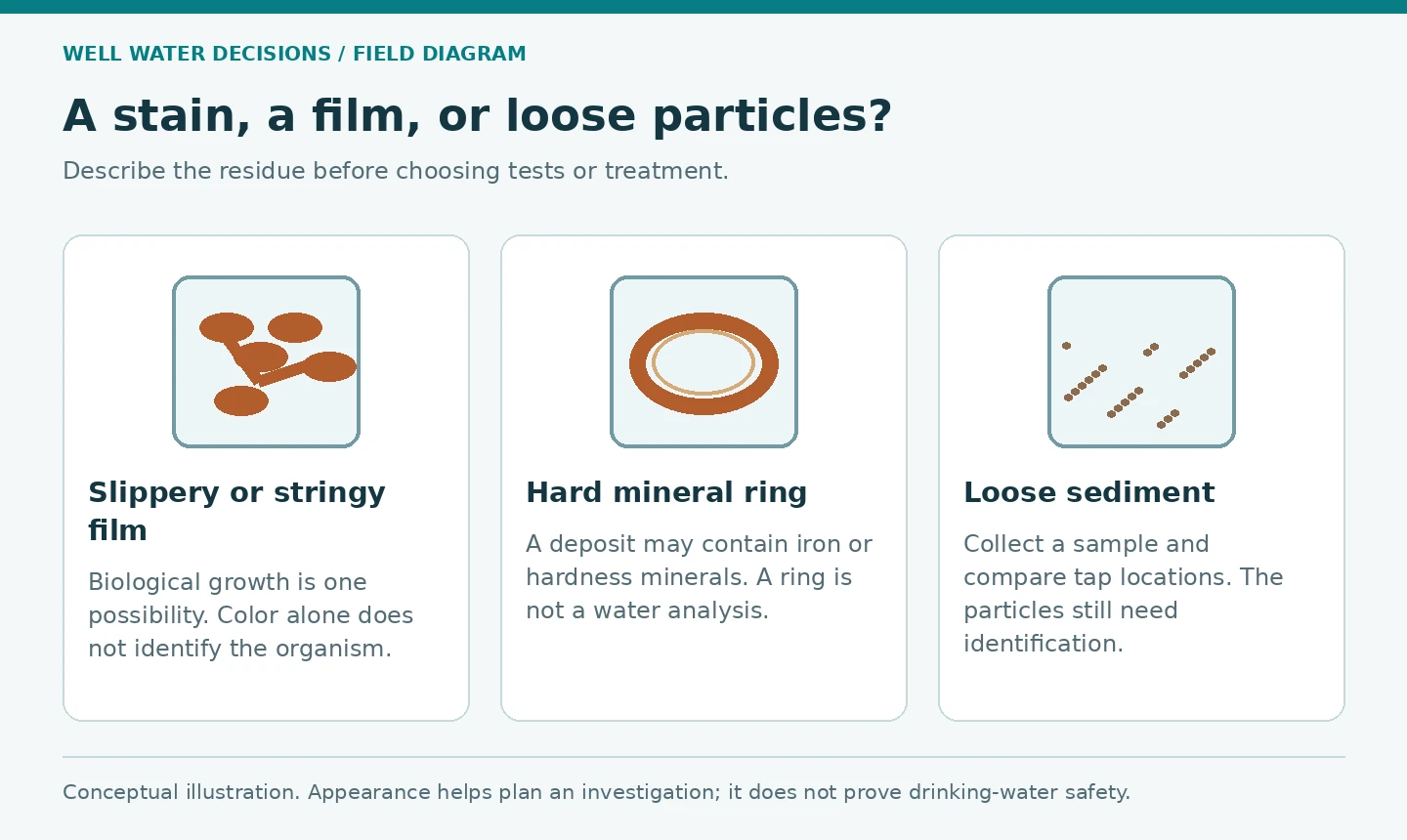
Compare the Residue Before Buying Treatment
Iron bacteria obtain energy from iron and can leave rust-colored deposits with a sticky coating. Mineral precipitation can also leave orange sediment without the same obvious slime. The Minnesota Department of Health describes both staining and slimy deposits as clues during an iron-bacteria investigation.
| Observation | Useful next check | Do not conclude |
|---|---|---|
| Slippery or stringy orange film | Record where it returns after cleaning; discuss biofilm with a well professional. | That a particular organism is confirmed by color. |
| Loose rusty sediment | Compare incoming water and ask about iron testing. | That every particle came from the well rather than plumbing. |
| A hard ring at the waterline | Check for mineral deposits and use fixture-approved cleaning. | That the ring measures iron concentration or hardness. |
Locate the Affected Part of the System
- Photograph the tank before cleaning. Note the date, odor, texture, recent plumbing work, and whether the toilet has been unused. Wash your hands after inspection; avoid splashes and contact with the eyes.
- Compare another toilet and a cold-water faucet. Material found only inside one tank deserves a check of that tank’s surfaces and components. Similar deposits at several outlets justify tracing the common supply.
- Identify actual treatment routing. An outside faucet may bypass a softener or filter, but do not assume it does. Use a plumbing diagram or ask the installer before calling a sample “untreated.”
- Separate observations from samples. A household glass can show visible particles; it is not a sterile microbiological sample container. Follow the laboratory’s collection instructions for meaningful test results.
Track What Returns After Cleaning
Use the same photo angle and name each fixture. Bring this record to the laboratory or well contractor; recurrence is evidence to investigate, not a way to identify an organism.
| Record | Your notes |
|---|---|
| Fixture and date | Toilet/location: __________ Date: __________ |
| Deposit and water appearance | Texture/color: __________ Cold-tap observation: __________ |
| Treatment routing | Confirmed treatment/bypass path: __________ Unknown: __________ |
| Cleaning and equipment service | Fixture-approved cleaner/method: __________ Date: __________ |
| Well or plumbing work | Work performed and date: __________ |
| Return of the deposit | First observed again: __________ Same or other fixtures: __________ |
A hard ring without slippery material belongs in the toilet-bowl rust-stain investigation. A photograph can preserve a pattern; neither a photograph nor the time to recurrence measures iron concentration or confirms bacteria.
Choose Useful Water Tests
Ask a certified drinking-water laboratory or local health department about the symptoms and your well history. EPA recommends annual private-well testing for total coliform bacteria, nitrate, total dissolved solids, and pH, with additional testing based on local risks or changes in the water. Iron and manganese measurements can help explain staining. Routine coliform testing does not identify iron bacteria.
Discuss whether a separate iron-bacteria investigation is useful and available locally. Sampling before treatment and at a household tap can answer different questions; let the laboratory specify the locations, collection procedure, and handling. Clear-looking water and an iron result do not replace tests for health-related contaminants.
Why Can Slime Remain After a Negative Coliform Test?
A routine coliform result answers a different question from an iron-bacteria investigation. Tell the laboratory about the returning deposit and ask whether a separate investigation is appropriate. A negative result does not identify the material in the tank.
Separate Fixture Cleaning From Well Treatment
For a deposit confined to the toilet, follow the toilet manufacturer’s care instructions. Kohler warns against in-tank cleaners because they can damage tank components. Do not drop chlorine tablets into a tank or filter housing as an improvised well-water treatment.
For recurring, system-wide slime, a qualified well contractor can assess the well and treatment equipment. Established deposits may require physical cleaning as well as an appropriately designed disinfection procedure. Do not copy a chemical dose from a forum: well dimensions, water chemistry, equipment compatibility, and contact conditions matter. Never mix chlorine products with acids or other cleaners.
If testing supports an iron-removal filter, check its actual operating requirements against your supply. Use the flow measurement guide and backwash flow checker before comparing equipment. A flow calculation helps size a hydraulic requirement; it does not identify bacteria or select a chemical treatment.
If the change follows flooding, well damage, or a suspected contamination event, contact the local health department promptly for testing and drinking-water instructions. Do not use the appearance of a cleaned tank as evidence that the well is safe.
What Each Intervention Addresses
| Intervention | Purpose and limit |
|---|---|
| Fixture-approved cleaning | Removes deposits at the fixture; it does not verify or disinfect the well. |
| Professional well cleaning/disinfection | Can address established well deposits and bacteria; the contractor determines the sequence and follow-up. |
| Test-supported iron treatment | Targets the identified water-quality problem under the equipment’s specifications; it does not automatically remove biofilm throughout the plumbing. |
MDH’s iron-bacteria guidance describes physical cleaning for heavily affected wells and warns that treatment may be only partly effective. Its caution about continuous chlorine injection into the well is not a blanket ruling on every professionally designed downstream treatment system.
Common Questions
Does orange slime always mean iron bacteria?
No. Iron bacteria can form rusty, slimy deposits, but color alone cannot identify an organism. Compare the texture and affected locations, then ask a laboratory or well professional which investigation fits the symptoms.
Will a water softener remove the slime?
A softener addresses hardness and may handle limited iron under its manufacturer's specifications. It does not disinfect a well or remove established biofilm throughout the plumbing. Test the water before choosing treatment.
Is the water safe if the toilet is the only affected fixture?
A deposit confined to one toilet makes a local source worth checking, but it does not establish drinking-water safety. Keep up private-well testing and investigate sudden changes, flooding, or illness with the local health department.