
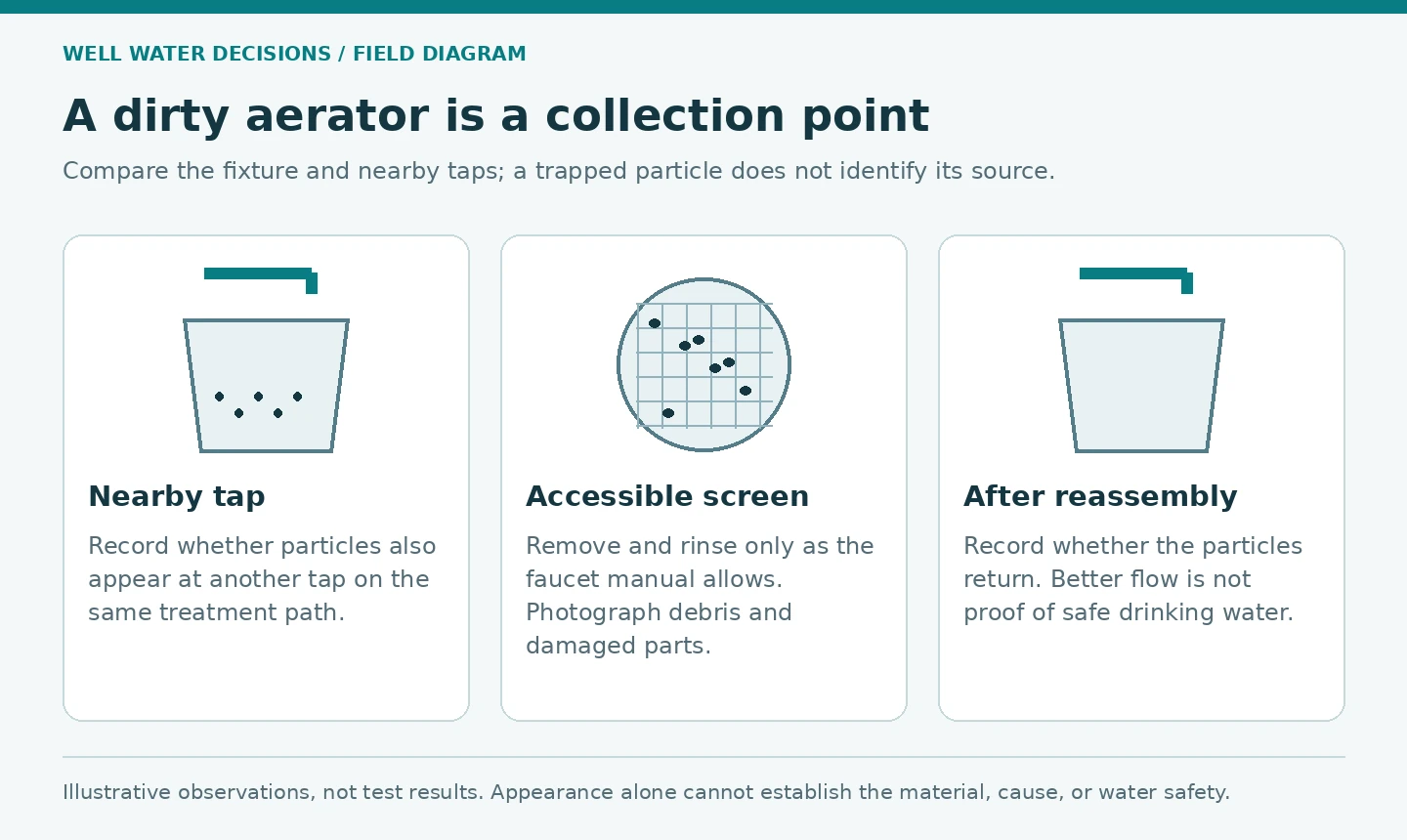
A dirty aerator is a collection point, not proof that the aerator created the black particles. Identify the faucet’s screen design, document the debris, and compare other outlets. Cleaning may restore flow while leaving an upstream problem unresolved.
Optional: flow calculator for treatment planning
INTERACTIVE WATER BALANCE / V1.0
Well Storage & Refill Calculator
Will usable stored water cover your entered demand sequence? Add each water-use stage, then compare the remaining water with the reserve you need to retain.
Calculation method and limits
Within a stage, flows are constant. End water = min(usable capacity, starting water + (refill − treatment − household flow) × minutes). The lowest balance in each constant-rate stage occurs at one of its endpoints. Inflow above capacity is not carried into the next stage. A balance below zero represents unmet demand, not physically available water.
The model works backward from the required reserve to find the least starting usable water that can retain that reserve throughout the sequence. If the required water exceeds usable capacity at any stage, no starting level within the entered capacity can cover that sequence. Arithmetic comparisons use a small floating-point tolerance.
Post-event refill time returns the reservoir to its entered starting level. It is not aquifer recovery time. If net refill is zero or negative and water was depleted, no finite refill time exists under those assumptions. A failed demand sequence has no valid recovery estimate.
Gallons alone do not establish delivery at pressure, sustainable well yield, drinking-water safety or an installation design. Source assessment, permitted operating levels, controls and equipment requirements need separate evidence. See the water-balance method, the worked example and the guide’s sources and review status.
Find the Correct Screen Design First
Moen documents several aerator arrangements: exposed threaded units, concealed designs, and faucets with inline filters rather than a visible screen. A pull-down spray head may have another service procedure. Do not assume every kitchen faucet tip simply unscrews.
Use the faucet model or manufacturer support to find its parts diagram and approved removal tool. If the instructions involve supply-line disconnection, that is a different task from rinsing an accessible aerator; it requires the specified isolation and leak checks. Stop if the model is unclear or a fitting will not move without force.
Keep the Debris and the Location Together
| Record | Reason |
|---|---|
| Only one faucet or several | Helps distinguish local hardware from a shared path. |
| Hot, cold, or both | Helps locate the affected supply without proving a failed component. |
| New filter, hose, or plumbing work | Adds a relevant service event. |
| Photo of screen and gasket before cleaning | Preserves the evidence and assembly order. |
Do not crush particles between your fingers or taste water to identify them. A dark smear can be made by different materials. The sample may need professional identification if the cause remains unexplained.
Rinse the User-Serviceable Parts
- Follow the model’s preparation and removal procedure. Close or cover the sink drain so small washers and inserts cannot fall into it.
- Photograph the order of removed parts. Rinse loose debris from the approved screen and inspect accessible inserts for visible damage.
- Use a mineral cleaner or soak only when the faucet and component instructions permit it. Protect the surrounding finish.
- Refit the correct gasket and inserts in their original order, using the specified tightening method. Check for leakage during normal operation.
Delta describes a cleaning method for removable aerators, while Moen shows why other designs need different access. Do not drill a screen, discard a flow-control insert, or leave a faucet permanently dismantled to improve flow.
If Particles Return After Cleaning
Record the recurrence and whether another tap on the same treatment path is affected. Have a plumber investigate repeated local debris or damaged faucet parts. Do not replace a water-heater hose or pressure tank solely because online commenters reported that fault in another home.
When several outlets are affected, follow our black-speck source investigation. For a separate ring around the sink drain, use localized drain-stain checks. Removing visible particles does not certify private-well water; keep routine and event-specific laboratory testing up to date.
Common Questions
If the water improves with the aerator removed, does that prove the faucet is the source?
No. The screen may be trapping material from elsewhere. Improvement helps locate a restriction, but the debris source still needs comparison with other outlets, service history, and any necessary analysis.
Can every faucet aerator be unscrewed with pliers?
No. Concealed, press-fit, inline-filter, and spray-head designs differ. Identify the model and approved procedure before applying force or disconnecting plumbing.