
A small amount of water confined to the filter recess can be normal on some dishwashers. Water spread across the tub floor, an incomplete drain, or water returning later needs a different check. Cloudiness alone does not tell you whether the drain pump has failed.
Optional: flow calculator for treatment planning
INTERACTIVE WATER BALANCE / V1.0
Well Storage & Refill Calculator
Will usable stored water cover your entered demand sequence? Add each water-use stage, then compare the remaining water with the reserve you need to retain.
Calculation method and limits
Within a stage, flows are constant. End water = min(usable capacity, starting water + (refill − treatment − household flow) × minutes). The lowest balance in each constant-rate stage occurs at one of its endpoints. Inflow above capacity is not carried into the next stage. A balance below zero represents unmet demand, not physically available water.
The model works backward from the required reserve to find the least starting usable water that can retain that reserve throughout the sequence. If the required water exceeds usable capacity at any stage, no starting level within the entered capacity can cover that sequence. Arithmetic comparisons use a small floating-point tolerance.
Post-event refill time returns the reservoir to its entered starting level. It is not aquifer recovery time. If net refill is zero or negative and water was depleted, no finite refill time exists under those assumptions. A failed demand sequence has no valid recovery estimate.
Gallons alone do not establish delivery at pressure, sustainable well yield, drinking-water safety or an installation design. Source assessment, permitted operating levels, controls and equipment requirements need separate evidence. See the water-balance method, the worked example and the guide’s sources and review status.
Locate the Water Before Calling It a Fault
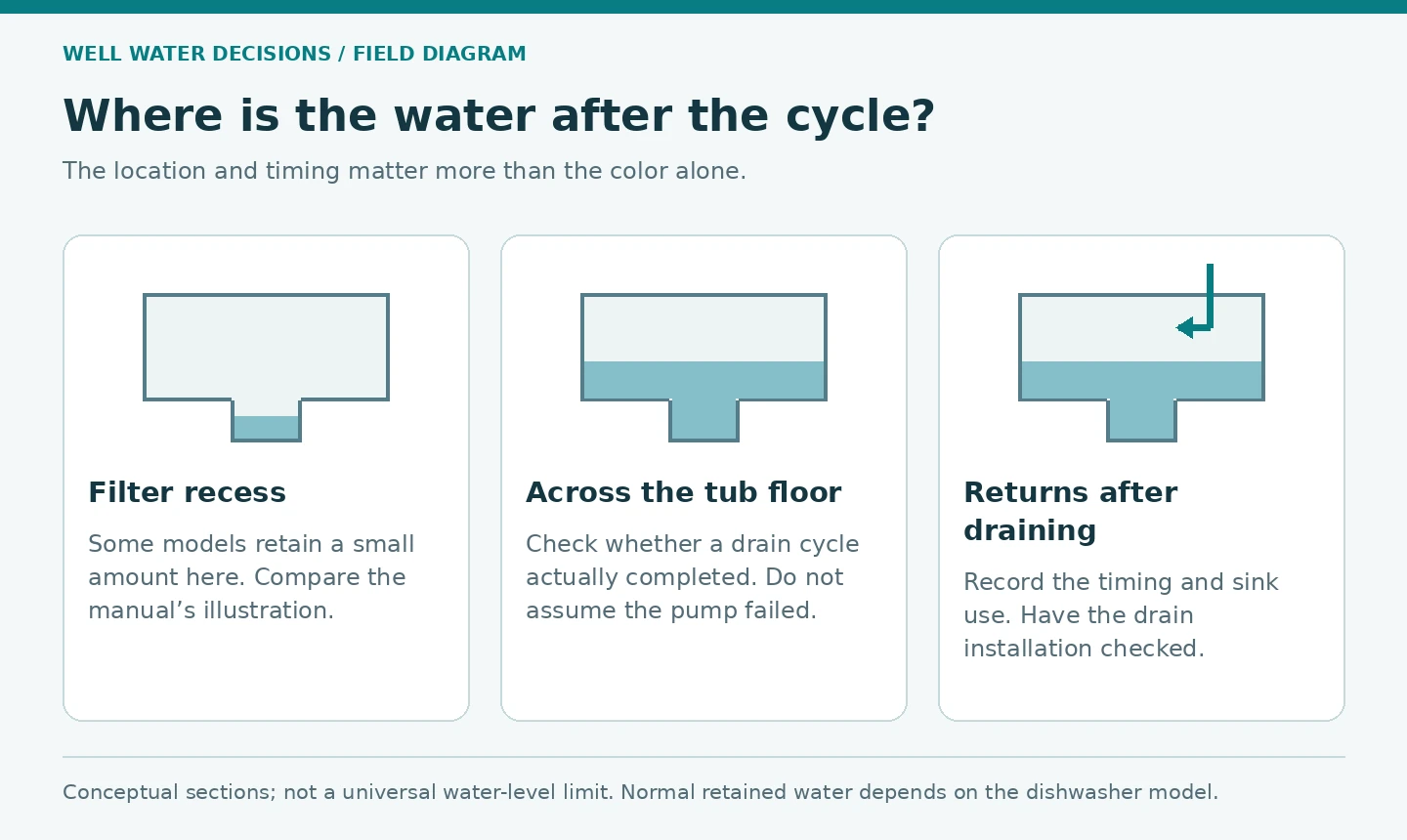
Whirlpool explains that some water remains in the filter area to help keep seals moist. Compare the owner’s manual illustration and the condition after a completed cycle. There is no universal depth that applies to every tub and filter design.
Check the control display for a paused cycle or error before restarting anything. If water is leaking onto the floor, stop the appliance and follow its shutdown instructions. Do not keep running wash cycles to see whether a leak will clear.
Check Accessible Maintenance Items
| Check | Action |
|---|---|
| Cycle did not finish | Use the model’s cancel/drain instructions; a short wash program is not a universal drain command. |
| Removable filter contains food | Switch off as directed, remove and clean only the user-serviceable filter, then reinstall and lock it correctly. |
| Visible hose is kinked | Record the condition for the installer; do not pull the appliance against connected hoses or wiring. |
| Disposer was recently installed | Ask the installer to verify the dishwasher connection and required knockout removal. |
Broken glass can hide in a filter or sump. Do not reach blindly into standing water or remove a pump cover unless the owner’s manual specifically describes that maintenance. A clean filter does not rule out a downstream blockage, and pump noise does not identify the failed part.
If Water Returns After It Drains
Write down when the tub fills again: immediately, after sink use, or much later. This timing helps an installer investigate the drain connection and possible backflow. It is not proof of the cause by itself.
The installation instructions and local requirements determine the drain-hose arrangement, including whether an air gap is needed. A generic “raise the hose” repair is not a substitute for checking the actual installation. If an air gap is fitted, clean only the user-accessible parts as its instructions permit.
Also report unusual suds and any use of hand-dishwashing liquid. Use only detergent intended for the appliance; an oversudsing problem and a blocked drain require different responses.
What to Give the Technician
Provide the full model, error code, photos of the water location, whether cancel/drain changes it, and recent disposer, sink, or appliance work. Persistent pooling after the approved checks, sewage-like backflow, leakage, or electrical problems warrants service. Avoid continued dishwashing while contaminated water is returning.
If the machine drains normally but develops colored film, use the dishwasher residue and cleaning guide. If the concern is a white film left on glassware, compare removable deposits and permanent etching. Well-water filtration is not a repair for an incorrectly connected dishwasher drain.
Common Questions
Is it normal for the dishwasher to have a layer of water at the bottom?
A small amount confined to the filter recess can be normal on some models. A layer across the tub floor needs comparison with the manual and a check that the drain cycle finished. Location and timing matter more than color.
Does standing water mean the drain pump is broken?
No. An incomplete cycle, filter obstruction, drain connection, hose issue, or other fault may be involved. Check the user-serviceable items and installation history before ordering a pump.