White, chalky deposits can be consistent with hard-water scale, but appearance does not measure hardness. Soap residue and cleaning products can leave pale films too. Compare the deposit with a water-hardness result before choosing whole-house equipment.
Optional: flow calculator for treatment planning
INTERACTIVE WATER BALANCE / V1.0
Well Storage & Refill Calculator
Will usable stored water cover your entered demand sequence? Add each water-use stage, then compare the remaining water with the reserve you need to retain.
Calculation method and limits
Within a stage, flows are constant. End water = min(usable capacity, starting water + (refill − treatment − household flow) × minutes). The lowest balance in each constant-rate stage occurs at one of its endpoints. Inflow above capacity is not carried into the next stage. A balance below zero represents unmet demand, not physically available water.
The model works backward from the required reserve to find the least starting usable water that can retain that reserve throughout the sequence. If the required water exceeds usable capacity at any stage, no starting level within the entered capacity can cover that sequence. Arithmetic comparisons use a small floating-point tolerance.
Post-event refill time returns the reservoir to its entered starting level. It is not aquifer recovery time. If net refill is zero or negative and water was depleted, no finite refill time exists under those assumptions. A failed demand sequence has no valid recovery estimate.
Gallons alone do not establish delivery at pressure, sustainable well yield, drinking-water safety or an installation design. Source assessment, permitted operating levels, controls and equipment requirements need separate evidence. See the water-balance method, the worked example and the guide’s sources and review status.
Compare Crust, Film, and Corrosion
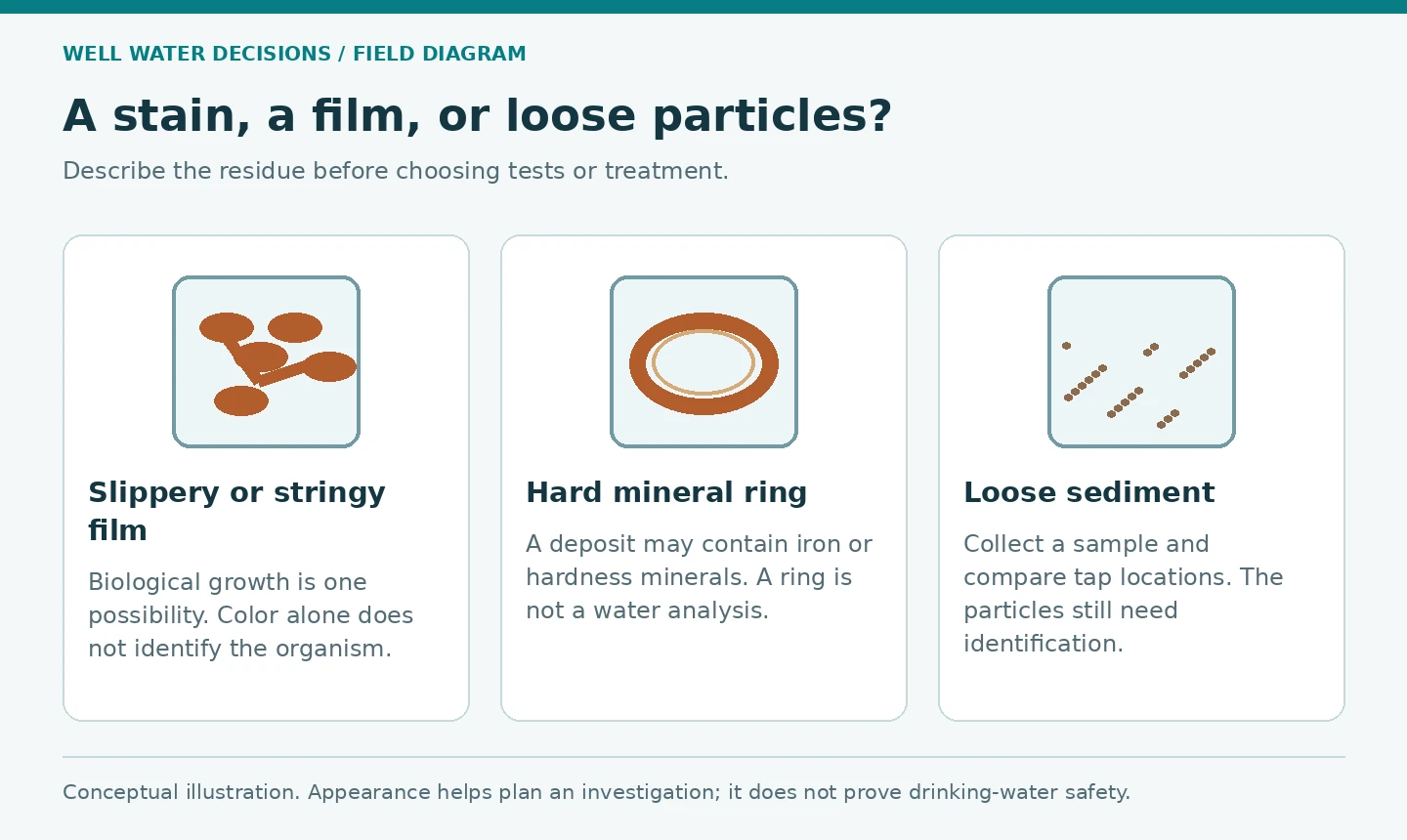
| What you see | Useful question |
|---|---|
| Hard white crust at a wet/dry boundary | Does the supplying water test hard, and is scale forming elsewhere? |
| Soft film near soap or detergent | Could product residue or soap scum contribute? |
| Blue-green staining or pinholes | Is plumbing corrosion involved rather than simple white scale? |
USGS defines hardness largely by dissolved calcium and magnesium and explains that heating hard water can produce calcium carbonate deposits. That mechanism can explain recurring scale, but it does not prove the identity of every white particle.
Measure Hardness at the Relevant Supply
Ask for a hardness measurement with its units recorded, usually mg/L as calcium carbonate or grains per gallon. If a softener is installed, compare a confirmed untreated point with water downstream of the unit. An outdoor faucet is not necessarily untreated; confirm the routing first.
A conductivity-based TDS meter estimates overall dissolved ionic content. It does not selectively measure calcium and magnesium and cannot replace a hardness test. Test strips can be useful screening tools when used as directed; a laboratory is appropriate when the composition or treatment choice remains uncertain.
Match the Cleaner to the Surface
- Identify the faucet finish, sink material, glass coating, and appliance model before choosing an acid or abrasive.
- Use the maker’s approved cleaning method and the cleaner label. A product suitable for a plain glass sample may damage natural stone, plated finishes, grout, or seals.
- Use one cleaning product at a time. Never combine an acid descaler with bleach or another cleaner.
- Record whether a clean surface develops new deposits during normal use. Cleaning old crust does not reduce incoming hardness.
For glassware, use the film versus etching checks; an acid-resistant haze is not automatically confirmed etching. For blue-green staining, follow the corrosion sampling guide.
Choose Treatment for a Measured Problem
Hardness, iron staining, persistent suspended particles, and microbial contamination are different treatment tasks. A sediment cartridge captures particles; an ordinary carbon filter does not automatically soften water. An ion-exchange softener reduces hardness, but selection also depends on water chemistry, household use, maintenance, and the equipment’s limits.
Do not size a filter from a stain photograph. For any proposed backwashing equipment, compare the documented flow and drain requirements with the measured water supply. Keep routine private-well health testing separate from the scale investigation.
Common Questions
Does a normal TDS reading rule out hard water?
No. TDS and hardness describe different things. Use a hardness test and retain its units; a conductivity meter cannot identify which minerals account for its reading.
Will a sediment filter stop scale?
A sediment filter can capture some existing particles. Dissolved hardness can pass through and form scale later, particularly on heated surfaces. Match treatment to the measured water problem.