
Inspect the glass when it is cool and dry before calling cloudiness hard-water scale. Temporary shower fog, a removable surface film, and damaged glass or coating can look similar while wet. Their cleaning limits are different.
Optional: flow calculator for treatment planning
INTERACTIVE WATER BALANCE / V1.0
Well Storage & Refill Calculator
Will usable stored water cover your entered demand sequence? Add each water-use stage, then compare the remaining water with the reserve you need to retain.
Calculation method and limits
Within a stage, flows are constant. End water = min(usable capacity, starting water + (refill − treatment − household flow) × minutes). The lowest balance in each constant-rate stage occurs at one of its endpoints. Inflow above capacity is not carried into the next stage. A balance below zero represents unmet demand, not physically available water.
The model works backward from the required reserve to find the least starting usable water that can retain that reserve throughout the sequence. If the required water exceeds usable capacity at any stage, no starting level within the entered capacity can cover that sequence. Arithmetic comparisons use a small floating-point tolerance.
Post-event refill time returns the reservoir to its entered starting level. It is not aquifer recovery time. If net refill is zero or negative and water was depleted, no finite refill time exists under those assumptions. A failed demand sequence has no valid recovery estimate.
Gallons alone do not establish delivery at pressure, sustainable well yield, drinking-water safety or an installation design. Source assessment, permitted operating levels, controls and equipment requirements need separate evidence. See the water-balance method, the worked example and the guide’s sources and review status.
Compare Fog With a Mark Left on Dry Glass
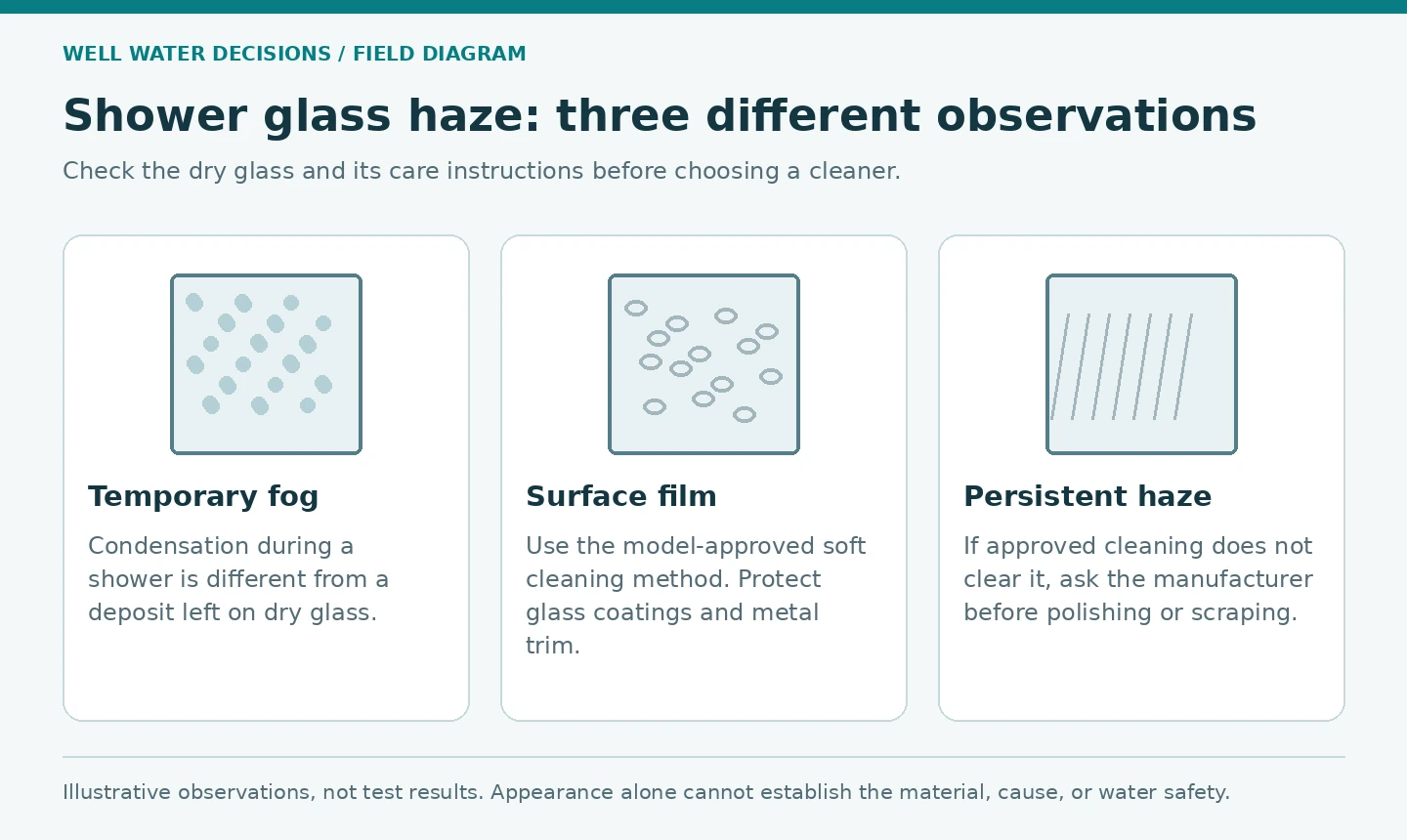
Kohler states that its CleanCoat treatment does not prevent fogging during a shower. Fog during use therefore does not prove a failed coating. Record whether the haze remains after ventilation and normal drying, and whether it follows splash zones, hardware, or a previous abrasive-cleaning pattern.
If the water itself is cloudy in a container, that is a separate issue covered by our cloudy well-water guide. A shower door has no “glass-door supply line” to sample; investigate the water at an actual outlet.
Identify the Coating and Adjacent Materials
Find the door model and care guide before applying a commercial remover. The glass may have a factory coating such as CleanCoat, Spot Guard, or ClearMax; the frame, hinges, seals, and tray can each have different restrictions.
Sterling, Delta, and DreamLine all emphasize soft cleaning methods and avoiding abrasive damage. Delta’s Spot Guard guidance also restricts particular chemicals. A bottle advertised for hard water is not automatically suitable for the coating or nearby metal finish.
Do not start with steel wool, an abrasive pad, a razor blade, a polishing compound, or a drill attachment. These can change the surface before anyone has established whether the haze is a deposit. Do not apply an aftermarket coating over an unidentified problem.
Clean a Small Area Using the Approved Method
| Step | What it tells you |
|---|---|
| Use the manufacturer-approved mild method on a small area | May show whether accessible surface soil can be removed without escalating products. |
| Rinse and dry as directed | Allows comparison without judging through a film of cleaner or water. |
| Compare in the same light | Documents improvement or persistent haze. |
| Photograph any unchanged rough or scratched area | Gives manufacturer support evidence before further treatment. |
Improvement is useful, but it does not establish the deposit’s complete chemistry. Lack of improvement is also not a definitive home test for etching, silica, or coating failure. Contact the door manufacturer before stronger chemicals or polishing.
Never mix bleach with an acidic scale remover. Do not allow a permitted glass cleaner to soak on hardware that prohibits it. Chips, cracks, damaged edges, loose fittings, or door misalignment need installer assessment; cleaning is not a repair for damaged safety glass.
Reduce Recurrence Without Guessing Treatment
Where the care guide permits, rinse and use a soft squeegee or cloth after a shower. This reduces the time water and soap residue remain on the door. Keep ventilation and routine cleaning appropriate to the room and product.
If mineral deposits recur throughout the home, use measured hardness and white-scale checks before selecting treatment. A softener cannot reverse a scratch or restore missing glass coating. This shower-door task is also different from dishwasher glassware etching, where wash chemistry and heat matter.
Common Questions
Does fogging mean the protective shower-glass coating has failed?
No. Kohler specifically notes that CleanCoat does not prevent fogging during shower use. Check the dry surface and the exact care guide before interpreting the haze as coating damage.
If vinegar does not clear the glass, is it definitely etched?
No. An unsuccessful cleaner is not a reliable identification test, and vinegar may be restricted by the product’s care instructions. Have persistent haze assessed before trying abrasives, stronger acids, or polishing.