
Stop consuming affected water or ice when you find unexplained pink slime in the dispensing path. Discard affected ice and identify the parts your refrigerator manual allows you to clean. A removable bin, an external drip tray, and an internal water line require different procedures.
Optional: flow calculator for treatment planning
INTERACTIVE WATER BALANCE / V1.0
Well Storage & Refill Calculator
Will usable stored water cover your entered demand sequence? Add each water-use stage, then compare the remaining water with the reserve you need to retain.
Calculation method and limits
Within a stage, flows are constant. End water = min(usable capacity, starting water + (refill − treatment − household flow) × minutes). The lowest balance in each constant-rate stage occurs at one of its endpoints. Inflow above capacity is not carried into the next stage. A balance below zero represents unmet demand, not physically available water.
The model works backward from the required reserve to find the least starting usable water that can retain that reserve throughout the sequence. If the required water exceeds usable capacity at any stage, no starting level within the entered capacity can cover that sequence. Arithmetic comparisons use a small floating-point tolerance.
Post-event refill time returns the reservoir to its entered starting level. It is not aquifer recovery time. If net refill is zero or negative and water was depleted, no finite refill time exists under those assumptions. A failed demand sequence has no valid recovery estimate.
Gallons alone do not establish delivery at pressure, sustainable well yield, drinking-water safety or an installation design. Source assessment, permitted operating levels, controls and equipment requirements need separate evidence. See the water-balance method, the worked example and the guide’s sources and review status.
Locate the Film Before Choosing a Procedure
| Location | Appropriate route |
|---|---|
| External drip tray or accessible dispenser surface | Follow the surface-specific wiping, rinsing, and drying instructions. |
| Removable ice bin | Follow the manual’s shutdown, removal, and approved hand-cleaning method. |
| Chute, auger, or moving mechanism | Clean only accessible approved surfaces; do not reach into moving parts. |
| Internal tubing, reservoir, or ice-making assembly | Ask the manufacturer for a validated procedure or qualified service. |
Pink coloration cannot identify a species or determine the water’s safety. Photograph the location, record odors or other water changes, and note when the bin was last cleaned or the filter replaced. Do not scrape suspected growth from inside a tube with a wire or pipe cleaner.
Clean Removable Parts Without Damaging Them
Use the owner’s manual to identify how to stop ice production and safely remove the bin. Keep hands away from the auger and ice-maker mechanism. Do not pour hot water onto a frozen glass shelf or force a bin held by ice.
GE and Frigidaire provide material-specific cleaning guidance. Plastic bins and trim are not automatically dishwasher-safe; bleach or harsh cleaners may be prohibited. Use only the approved product and method, rinse food-contact parts as directed, dry, and reinstall correctly.
Keep cleaning liquid away from electrical controls and unapproved openings. A cloth-cleaning instruction for the dispenser exterior is not permission to pour cleaner into the water outlet. Discard ice produced during any model-specific recommissioning procedure.
A Refrigerator Is Not a Standalone Ice Machine
Some standalone ice machines have a dedicated cleaner reservoir and cleaning cycle. A refrigerator’s automatic ice maker may have neither. Do not transfer a standalone machine’s descaler quantity or circulation procedure to refrigerator tubing.
If film extends into an inaccessible water path, returns promptly after permitted cleaning, or accompanies damaged components, arrange manufacturer-authorized service. Replacing a carbon filter does not clean or sanitize every downstream component. Do not inject bleach, vinegar, or another chemical into the refrigerator supply line.
Compare the Supply Without Treating Color as a Test
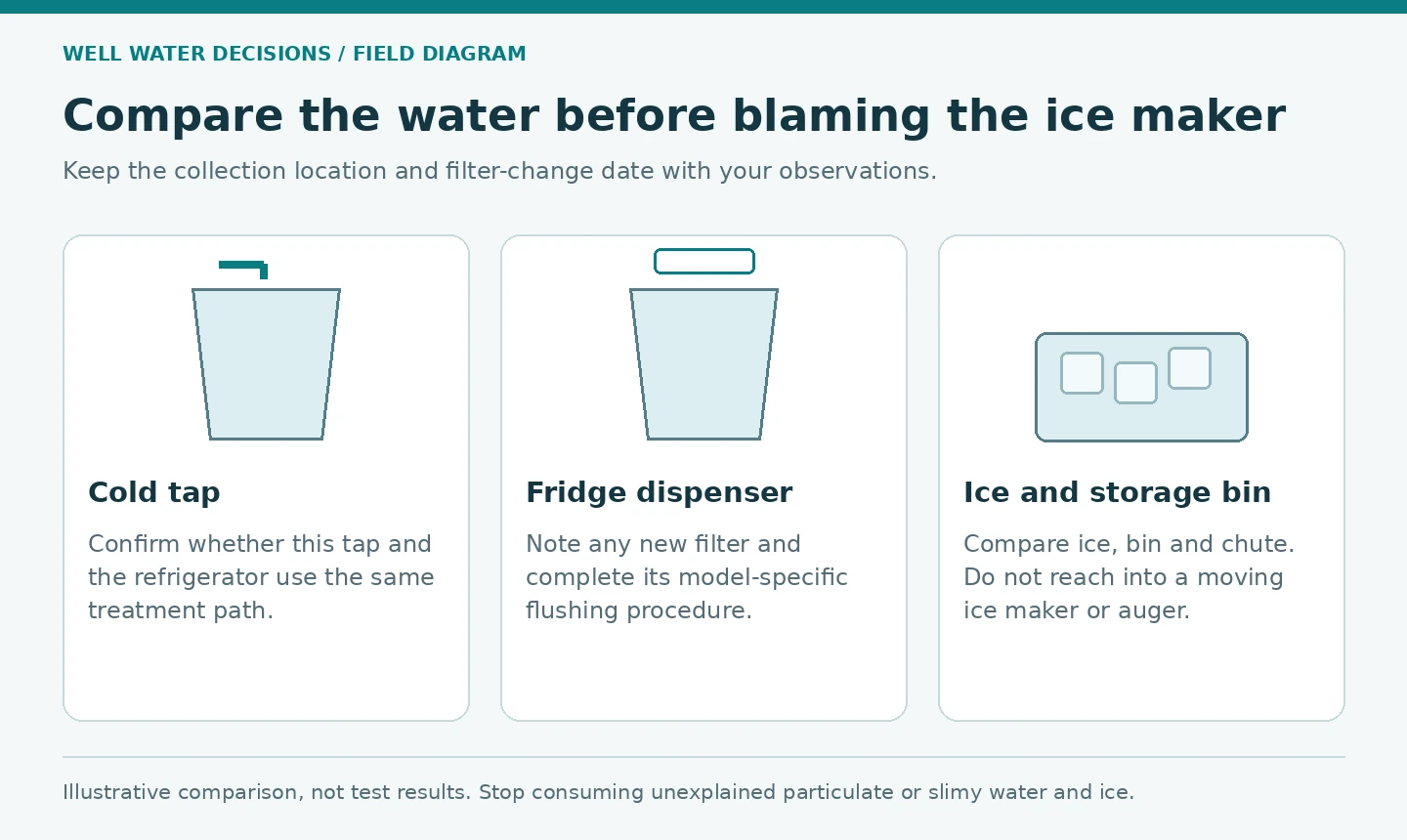
Confirm whether the refrigerator and comparison tap use the same treatment path. Report changes in tap water as well as the ice. A certified laboratory or health department can advise on appropriate private-well sampling and any use restrictions while the cause is investigated.
For dry dark particles rather than pink film, see black specks in ice. For pink film on bathroom surfaces, use the separate bathroom cleaning and source checks. Neither comparison identifies an organism or justifies an improvised well-disinfection dose.
Common Questions
Does a new refrigerator filter remove slime from the ice maker?
A replacement filter does not clean or sanitize all downstream tubing, ice-making components, and storage surfaces. Follow the model’s cleaning and recommissioning instructions, with service for inaccessible contamination.
Can I use a standalone ice-machine cleaner in my refrigerator?
Only if the refrigerator manufacturer specifically approves that product and procedure for the exact model. Standalone machines may have dedicated reservoirs and cleaning cycles that refrigerator ice makers do not have.